
Various options are provided as possible answers to the following questions. Choose the answer and write only the letter (A–D) next to the question numbers (1.1 to 1.10) in the ANSWER BOOK, e.g. 1.11 E. Each question has only ONE correct answer.
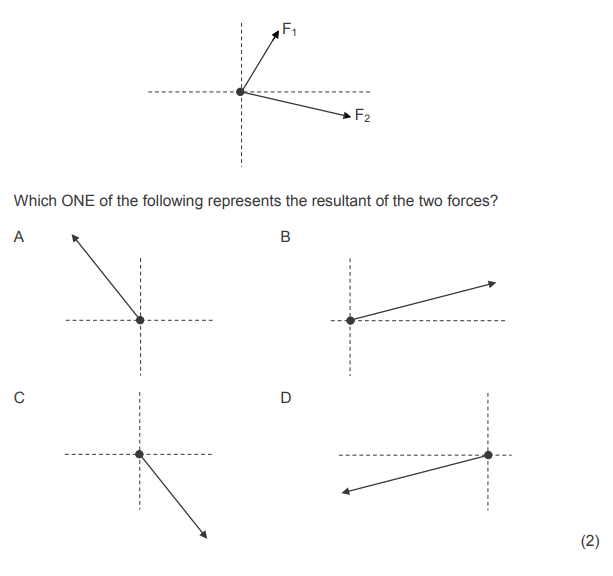
1.1 Two forces, F1 and F2, act simultaneously at a point in the directions as shown in the sketch below.
1.2 Which ONE of the following statements regarding inertia of an object is CORRECT?
The inertia of an object …
A is greater if its mass is smaller.
B increases as the applied force on the object increases.
C is the resistance to any change in its state of motion.
D increases as the frictional force on the object increases.
1.3 Which ONE of the following statements regarding the frictional force acting on an object is CORRECT?
The frictional force is …
A directly proportional to the normal force.
B dependent on the velocity of the motion.
C independent of the type of surface.
D equal to the weight of the object. (2)
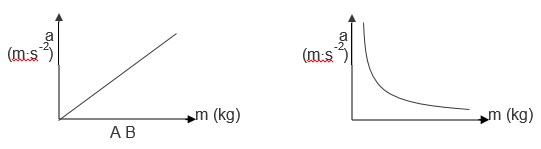
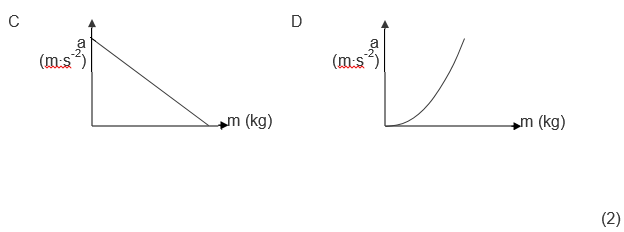
1.4 Which ONE of the following graphs represents the relationship between acceleration and mass of an object if a constant net force acts on it?
1.5 According to Newton’s Third Law of Motion, the reaction force to the weight of a book lying on a table is the …
A normal force.
B force of the book on Earth
C force of Earth on the book.
D force of the book on the table. (2)
1.6 The measure of the refractive power of a medium is called the …
A refractive index.
B optical density.
C refraction.
D speed of light in the medium.
1.7 A central bright band is observed when light of wavelength λ travels through a slit of width w.
Light of wavelength 2λ is now used. A central bright band of the SAME broadness will be produced if the slit width used is …
A w
B ½w
C ¼wz
D 2w (2)
1.8 The electric field at a point is defined as …
A the region in space where an electric charge experiences an electrostatic force.
B the electrostatic force per unit positive charge.
C directly proportional to the product of the charges
D the direction that a negative test charge would move. (2)
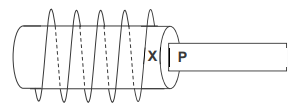
1.9 The diagram below shows a coil and a magnet with a pole, P. A magnetic field is induced in the coil due to the motion of the magnet.
1.10 The cell in the circuit below delivers a potential difference of 1,5 V. The bulbs
are identical and the current in the circuit is 0,2 A.
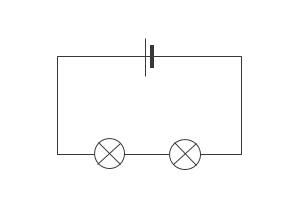
The energy, in joule, transferred by ONE of the bulbs in one minute is …
A 1,5 × 0,2 × 1
B 1,5 × 0,2 × 60
C 0,75 × 0,2 × 1
D 0,75 × 0,2 × 60 (2)
[20]